Jun 19, 2026
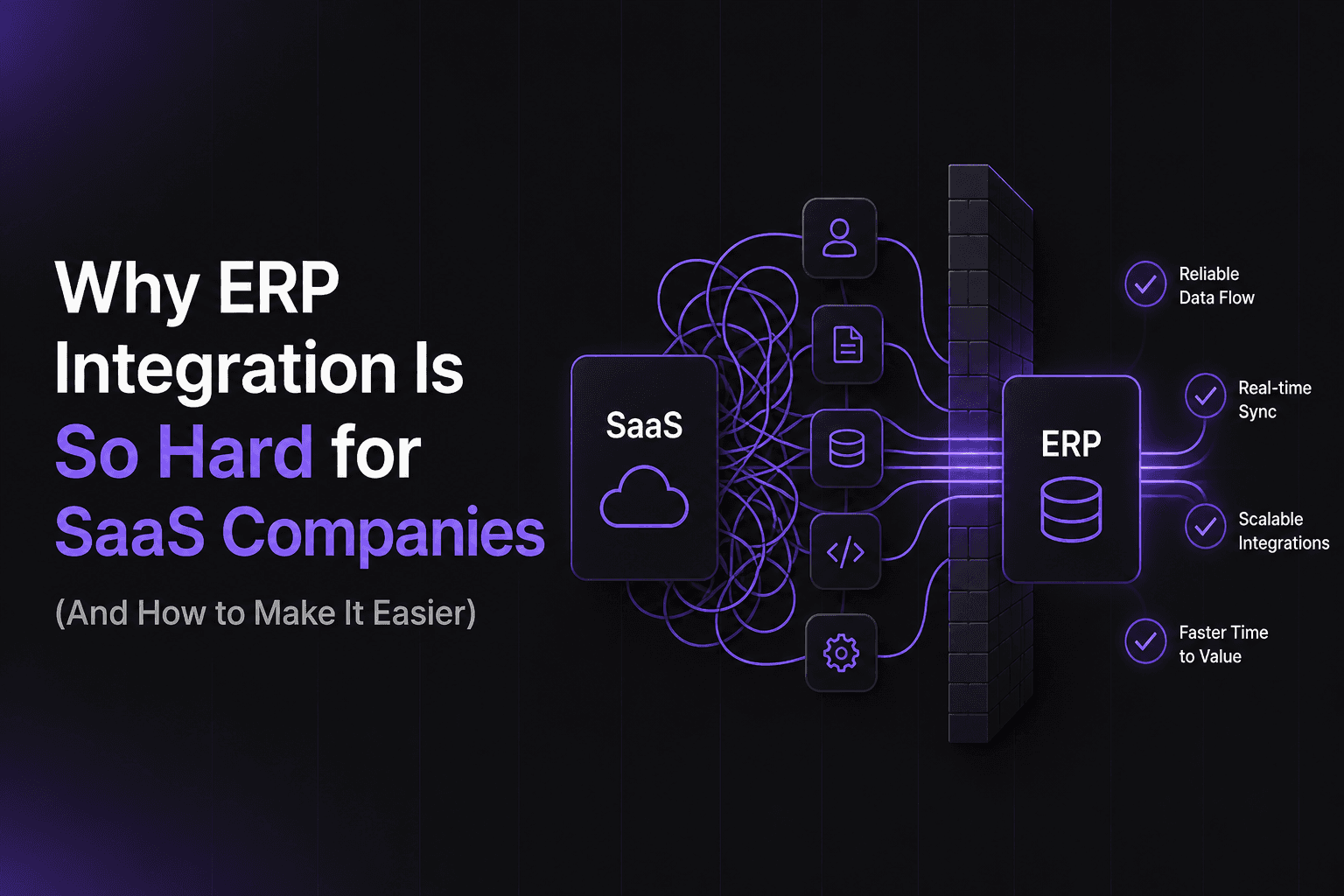
ERP (Enterprise Resource Planning) integration is the single hardest connector most SaaS companies will ever build. Where a Slack or Google Calendar integration might take a week, connecting your product to a customer's ERP, whether NetSuite, SAP, Microsoft Dynamics, or QuickBooks, routinely turns into a multi-month project that never quite finishes. And unlike a nice-to-have integration, ERP is usually the one blocking a six-figure deal.
This post explains why ERP integration is so disproportionately painful for SaaS companies, where the time actually goes, and how an embedded integration platform changes the economics of supporting it.
A note on framing: most ERP integration content is written for the company adopting an ERP. This isn't that. This is for the SaaS company whose customers already run ERPs, and who keeps getting asked, "Can your product connect to ours?"
Why Is ERP Integration Harder Than Other SaaS Integrations?
ERP integration is harder because ERPs are customized, fragmented, and mission-critical in ways that consumer and SMB SaaS APIs are not. A typical app integration connects to a stable, well-documented API with predictable fields. An ERP integration connects to a system that every customer has configured differently, often over a decade, with custom objects and business logic baked in.
Four things make it uniquely difficult:
Every ERP instance is different. Two companies both "on NetSuite" can have entirely different field structures, custom records, and workflows. There is no single NetSuite integration; there are as many as you have customers, each with its own customizations.
The data model is deep and unforgiving. ERPs are systems of record for money, inventory, and orders. A mismapped field doesn't just look wrong; it can throw off a customer's financial reporting or fulfillment. The tolerance for error is near zero.
The APIs are old and inconsistent. Many ERP APIs predate modern REST conventions. You'll encounter SOAP endpoints, batch-only operations, opaque rate limits, and authentication schemes that vary by product line. Integrating ERP systems via APIs usually comes with hurdles like rate limits, functionality gaps, and frequent updates that stall operations.
It's mission-critical, so it's high-stakes to maintain. Once a customer relies on the integration to sync invoices or inventory, any downtime is an incident. The maintenance burden never goes away.
What Does ERP Integration Actually Involve?
ERP integration involves connecting your SaaS product to a customer's ERP so that data, including orders, invoices, inventory, customers, and financials, flows between the two systems automatically and stays in sync.
In practice, a single ERP integration breaks down into several distinct pieces of engineering work:
Authentication and connection to an ERP instance, which may use OAuth, token-based auth, or older credential schemes depending on the system.
Field mapping between the customer's ERP schema (including their custom fields) and your product's data model.
Data transformation to reconcile formats, currencies, units, and identifiers across the two systems.
Sync logic to decide what syncs, in which direction, how often, and how to resolve conflicts when both sides change a record.
Error handling and monitoring so failed syncs are caught, retried, and surfaced before a customer notices a discrepancy in their financials.
Each of these is non-trivial on its own. Stacked together, per customer, they explain why ERP connectors consume so much engineering time.
How Much Does Building ERP Integration In-House Cost?
The honest answer is that the cost compounds in ways teams rarely budget for. The first ERP integration looks like a defined project. The problem is that it's never really "done," and it's never reused as cleanly as expected.
Initial build: A first NetSuite or SAP connector commonly takes 2 to 4 months of senior engineering time, factoring in auth, mapping, sync, and testing.
Per-customer customization: Because each ERP instance is configured differently, much of the "reusable" connector gets re-customized per customer, closer to a services engagement than a product feature.
Ongoing maintenance: ERP vendors deprecate endpoints and ship API changes; your team owns every break, indefinitely.
Opportunity cost: Every engineer-month on ERP plumbing is a month not spent on the core product roadmap.
The deeper cost is strategic. As you grow from 100 to 1,000 customers across multiple ERPs, the complexity compounds, and integration fragility at scale is a real concern. What worked as a one-off for your first enterprise customer becomes a fragile, sprawling liability by your fiftieth.
Which ERP Integrations Do SaaS Companies Need Most?
The ERPs that generate the most integration requests cluster around finance, operations, and fulfillment, because those are the systems of record your customers can't run their business without.
The most commonly requested include accounting and finance ERPs like QuickBooks, Xero, and NetSuite; larger enterprise suites like SAP and Microsoft Dynamics; and operations and inventory systems like Cin7 for product and fulfillment data. For e-commerce and operations SaaS specifically, requests often pair an ERP with a commerce or fulfillment system, like connecting NetSuite to Shopify, or an inventory tool to a marketplace.
The pattern is consistent: the integration that unblocks a deal is almost always to the customer's financial or operational system of record, and that's precisely the category that's hardest to build and riskiest to get wrong.
How Does an Embedded Integration Platform Make ERP Integration Easier?
An embedded integration platform makes ERP integration easier by moving the integration work off your engineering team and into your product, where your customers configure their own ERP connections, including their custom fields, without a per-customer engineering project.
The shift is structural. Instead of your engineers building and maintaining a bespoke NetSuite connector for each customer's instance, you embed the platform once. Your customer connects their own ERP, maps their own custom fields, and manages their own sync, inside your product, under your brand. The platform handles authentication, transformation, sync logic, retries, and monitoring underneath.
This directly addresses the two things that make ERP hard:
The "every instance is different" problem becomes a configuration task the customer (or your success team) handles in a UI, not a code change your engineers ship.
The maintenance burden moves to the platform, which absorbs ERP API changes so your team doesn't field every break.
Fastn takes this further with an AI-first approach: rather than hand-coding each ERP connector, AI agents handle the research, connector setup, and field mapping, then generate the integration logic for your team to review and approve. For a category as customization-heavy as ERP, having an agent do the per-instance mapping work is where most of the time savings come from. You can see the supported systems on the integrations page.
Frequently Asked Questions
How long does it take to build a NetSuite integration?
Built in-house, a first NetSuite connector commonly takes two to four months of senior engineering time, and then needs per-customer customization because every NetSuite instance is configured differently. On an embedded integration platform, the customer connects their own instance and maps their fields without a dedicated engineering project per customer.
Why is ERP integration more expensive than other integrations?
Because ERPs are deeply customized per customer, mission-critical, and built on older, inconsistent APIs. You're not building one integration; you're effectively building a variant for each customer's instance, and maintaining all of them as the ERP vendor changes its API.
Can you integrate with SAP and QuickBooks through the same platform?
Yes. An embedded integration platform exposes multiple ERP and accounting systems through one consistent layer, so you don't write and maintain a separate codebase for each. Your customers connect whichever system they use.
What's the difference between an ERP integration and an iPaaS?
An ERP integration is the specific connection between your product and an ERP. An iPaaS, or embedded integration platform, is the infrastructure that lets you build and run many such integrations, including ERP, without hand-coding each one.
Should a SaaS company build its own ERP connectors?
Only if a specific ERP integration is your core differentiator. For most SaaS companies, ERP connectors are a cost center that drains roadmap time, and an embedded integration platform is the more economical path.
This is a sensitive area for financial data. If you're handling customers' financial records through an integration, accuracy and data isolation matter, so validate any platform's tenant isolation and error-handling before relying on it for financial sync.
Bottom Line
ERP integration is hard for SaaS companies because every ERP instance is customized, the data is mission-critical, the APIs are old and inconsistent, and the maintenance never ends. Building these connectors in-house turns into a per-customer services engagement that quietly consumes your roadmap.
An embedded integration platform changes the math: it moves ERP configuration into your product, lets your customers connect their own instances, and absorbs the maintenance burden underneath. With an AI-first platform like Fastn, the per-instance mapping work that makes ERP so painful is handled by agents, with your team reviewing the output rather than writing it.
The integration blocking your next enterprise deal is probably an ERP. The question is whether your engineers should keep building those by hand, or whether that work should move into your product.
